
Characterization and mathematical modeling for dimmable LED lamp
Article Sidebar
Main Article Content
Abstract
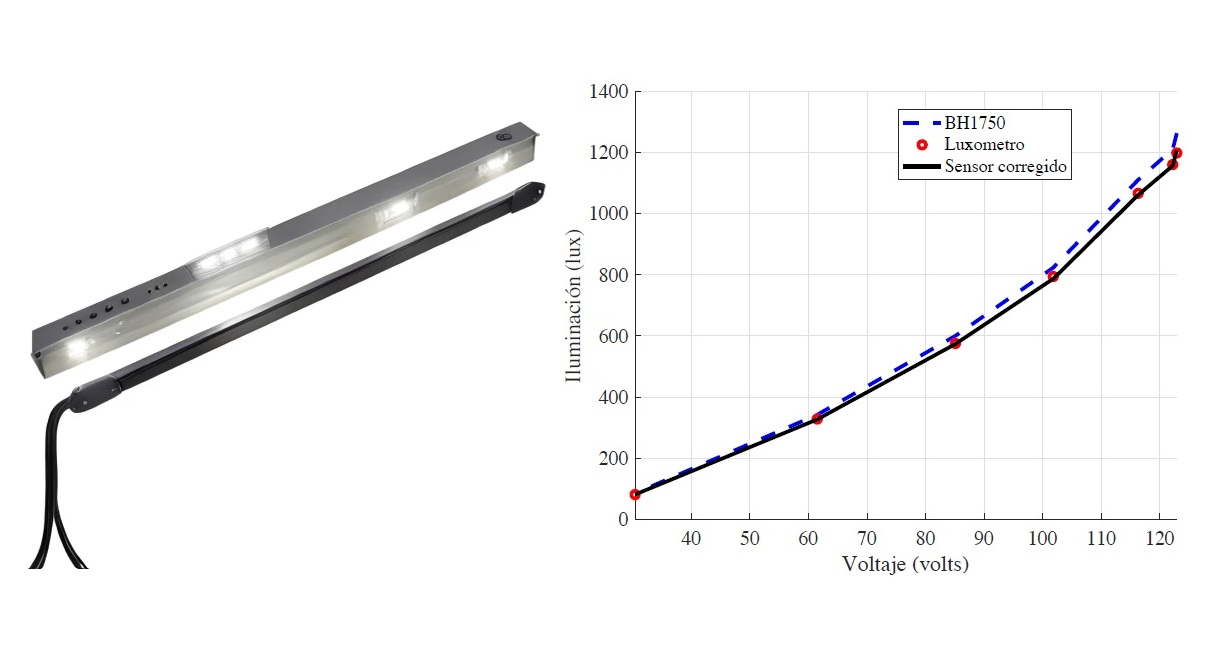
Energy saving in a context of accelerated population growth, depletion of energy resources and environmental concerns is relevant; a significant portion of the world's energy consumption is in buildings, and a large portion of this consumption is due to lighting. LED technology is an attractive solution for energy efficiency in lighting due to its long life and dimmability. This work aims to characterize the behavior of the LED lamp through a mathematical model, the result is an exponential equation; using Taylor series at an operating point, the mathematical linear model is determined. It is highlighted that both models are static, that is, they depend on the current state. These models will allow us to understand the relationship between input voltage and output illumination; it will be useful for the development of more efficient lighting control strategies.
Article Details
References
Al-Ghaili, A. M.-H. (2020). A review: Buildings energy savings—Lighting systems performance. IEEE Access, 76108–76119.
Bisegna, L. P. (2022). The impact of key parameters on the energy requirements for artificial lighting in Italian buildings based on standard EN 15193-1:2017. Energy and Buildings, 20–25.
Caicedo, A. P. (2011). Daylight integrated illumination control of LED systems based on enhanced presence sensing. Energy and Buildings, 944–950.
Chen, S. Y. (2012). Intelligent lighting control for vision-based robotic manipulation. IEEE Transactions on Industrial Electronics, 3254–3263.
Ekren, S. G. (2013). Energy saving in lighting system with fuzzy logic controller which uses light-pipe and dimmable ballast. Energy and Buildings, 172–176.
George, C. K. (2008). Robust control and optimisation of energy consumption in daylight—artificial light integrated schemes. Lighting Research & Technology, 7–24.
Chinchero, H. F., et al. (2020). A review on energy management methodologies for LED lighting systems in smart buildings. En 2020 IEEE International Conference on Environment and Electrical Engineering and 2020 IEEE Industrial and Commercial Power Systems Europe (EEEIC/I&CPS Europe) (pp. 1–6). IEEE.
Khalil, H. (2014). Nonlinear control. Pearson.
Santamouris, M. (2019). Minimizing energy consumption, energy poverty and global and local climate change in the built environment: Innovating to zero. Elsevier.
Sener. (2016). Balance nacional de energía. Ciudad de México.
Tecnolite. (2023). Ficha técnica T5D60-LED/10W/65. https://tecnolite.mx/c/p/foco-tubo-t5-led-10-w-55-centimetros-luz-de-dia-base-g5-atenuable/T5D60-LED_10W_65
Tzempelikos, I. K. (2020). The effect of lighting environment on task performance in buildings: A review. Energy and Buildings.
Wen, Y.-J., & Agogino, A. M. (2008). Wireless networked lighting systems for optimizing energy savings and user satisfaction. En 2008 IEEE Wireless Hive Networks Conference (pp. 1–7).