
Efecto de diferentes tipos de pretratamientos térmicos sobre la hidrólisis ácida del lirio acuático (Eichhornia crassipes) para producir azúcares reductores
Barra lateral del artículo
Contenido principal del artículo
Resumen
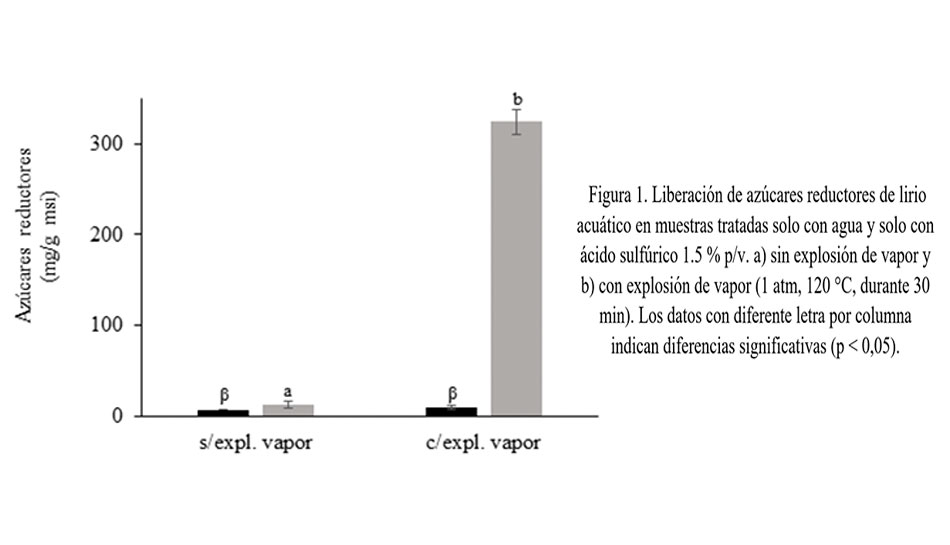
El lirio acuático como la mayoría de las plantas contiene en su pared celular polisacáridos como celulosa y hemicelulosa los cuales, pueden ser hidrolizados para la obtención de azúcares que a su vez pueden ser utilizados en procesos fermentativos y producir algunos biocombustibles. En este trabajo se evaluó el efecto de diferentes tipos de pretratamientos térmicos para llevar a cabo la hidrólisis ácida de lirio acuático, y se encontró que utilizando la explosión de vapor bajo la adición de ácido sulfúrico (1.5% p/v), 120 °C y 1 atm se obtuvo la máxima liberación de azúcares reductores (324.26 ± 13.4 miligramos/gramos de materia seca inicial) obteniendo un 70% más azúcares con respecto al uso de un baño con agua en ebullición con adición de ácido (1.5% p/v) pero a una temperatura de 92 °C y una presión de 0.77 atm.
Detalles del artículo
Citas
Balat M, Balat H, Öz C. (2008). Progress in bioethanol processing. Progress in energy and combustion science 34(5): 551-573. doi: /10.1016/j.pecs.2007.11.001.
Barua V B, Kalamdhad A S. (2017). Effect of various types of thermal pretreatment techniques on the hydrolysis, compositional analysis and characterization of water hyacinth. Bioresource Technology 227:147-154. doi: 10.1016/j.biortech.2016.12.036.
Barua V B, Goud V V, Kalamdhad A S. (2018). Microbial pretreatment of water hyacinth for enhanced hydrolysis followed by biogas production. Renewable Energy 126:21-29. doi: 10.1016/j.renene.2018.03.028.
Bayrakci A G y Koçar G. (2014). Second-generation bioethanol production from water hyacinth and duckweed in Izmir: A case study. Renewable and Sustainable Energy Reviews 30: 306-316. doi: 10.1016/j.rser.2013.10.011.
Boontum A, Phetsom J, Rodiahwati W, Kitsubthawee K, Kuntothom T. (2019) Characterization of diluted-acid pretreatmen of water hyacinth. Applied Science and Engineering Progress 12(4): 253-263. doi: 10.14416/j.asep.2019.09.003.
Brodeur G, Yau E, Badal K, Collier J, Ramachandran K B, Ramakrishnan S. (2011). Chemical and physicochemical pretreatment of lignocellulosic biomass: a review. Enzyme research 2011:1-17. doi:10.4061/2011/787532.
Cheng Y S, Chen K Y, Chou T H. (2015). Concurrent calcium peroxide pretreatment and wet storage of water hyacinth for fermentable sugar production. Bioresource technology 176: 267-272. doi: 10.1016/j.biortech.2014.11.016.
Ciolacu D E. (2018). Biochemical modification of lignocellulosic biomass. En: Popa V y Volf I. (eds) Biomass as renewable raw material to obtain bioproducts of high-tech value. Elsevier, Amsterdam, Holanda, pp 315-35.
Das A, Ghosh P, Paul T, Ghosh U, Pati B R, y Mondal K C. (2016). Production of bioethanol as useful biofuel through the bioconversion of water hyacinth (Eichhornia crassipes). 3 Biotech 6:1-9. doi: 10.1007/s13205-016-0385-y.
Jung H Y. y Kim H K. (2015). Acidic pretreatment. En: Pandey A, Negi S, Binod P, Larroche C (eds) Pretreatment of biomass. Elsevier, Amsterdam, Holanda, pp. 27-50. doi: 10.1016/B978-0-12-800080-9.00003-7.
Kumar S, Singh S P, Mishra I M, y Adhikari D K. (2009). Recent advances in production of bioethanol from lignocellulosic biomass. Chem Eng Technol 32(4):517-526. doi: 10.1002/ceat.200800442.
Ma F, Yang N, Xu C, Yu H, Wu J, y Zhang X. (2010). Combination of biological pretreatment with mild acid pretreatment for enzymatic hydrolysis and ethanol production from water hyacinth. Bioresource technology 101 (24):9600-9604. doi: 10.1016/j.biortech.2010.07.084.
Malik A. (2007) Environmental challenge vis a vis opportunity: The case of water hyacinth. Environment International 33(1):122-138. doi: 10.1016/j.envint.2006.08.004.
Miller G L, Blum R, Glennon W E y Burton A L (1960). Measurement of carboxymethylcellulase activity. Analytical Biochemistry 1(2):127-132. doi: 10.1016/0003-2697(60)90004-X.
Mishima D, Tateda M, Ike M, y Fujita M. (2006). Comparative study on chemical pretreatments to accelerate enzymatic hydrolysis of aquatic macrophyte biomass used in water purification processes. Bioresource technology 97(16):2166-2172. doi: 10.1016/j.biortech.2005.09.029.
Nigam J N. (2002). Bioconversion of water-hyacinth (Eichhornia crassipes) hemicellulose acid hydrolysate to motor fuel ethanol by xylose–fermenting yeast. Journal of Biotechnology 97(2):107-116. doi: 10.1016/S0168-1656(02)00013-5.
Rezania S, Din MF M, Mohamad S E, Sohaili J, Taib S M, Yusof M B M y Ahsan A (2017). Review on pretreatment methods and ethanol production from cellulosic water hyacinth. BioResources 12(1):2108-2124. doi: 10.15376/biores.12.1.
Rezania S, Ponraj M, Talaiekhozani A, Mohamad S E, Din M F M, Taib S M, y Sairan F M. (2015). Perspectives of phytoremediation using water hyacinth for removal of heavy metals, organic and inorganic pollutants in wastewater. Journal of environmental management 163:125-133. doi: 10.1016/j.jenvman.2015.08.018.
Sun Y, y Cheng J. (2002). Hydrolysis of lignocellulosic materials for ethanol production: a review. Bioresource technology 83(1):1-11. doi: 10.1016/S0960-8524(01)00212-7.